
 Claude
 Perplexity
Quick summary
- Most quotes for AC duct cleaning in Dubai only describe part of the job. A full service covers ducts, coil, blower, and drain pan, not just visible vents.
- Desert dust, near-constant AC use, and summer humidity mean Dubai homes accumulate duct contamination faster than most other climates, which shortens how often service is needed.
- The cleaning process matters as much as frequency: without negative pressure extraction, agitating dust inside a duct simply relocates it rather than removing it.
- Knowing the difference between a central ducted system and a split AC unit matters, because the process and the right questions to ask a provider differ for each.
- A clear understanding of what a thorough job looks like helps homeowners spot a shallow quote before work begins.
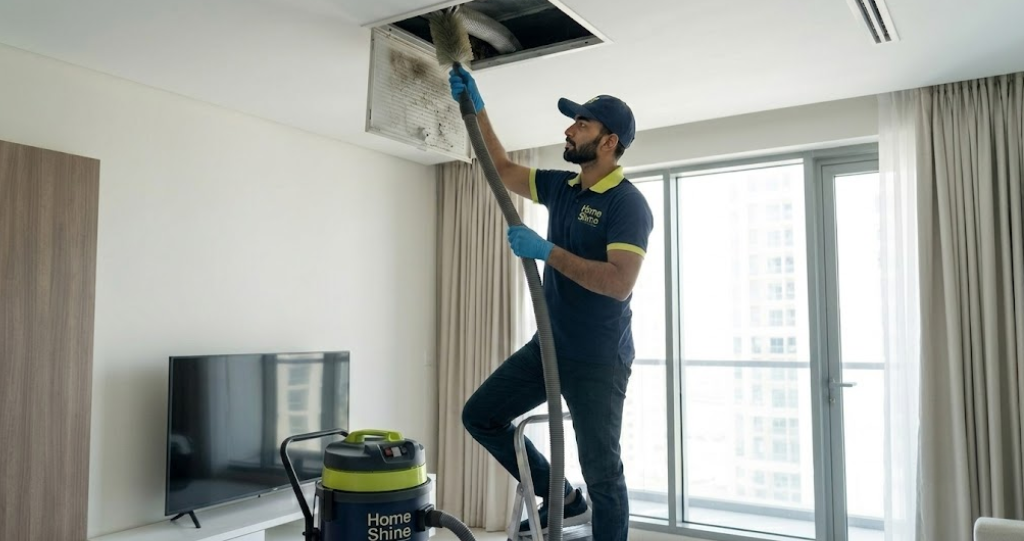
Anyone who has requested a quote for AC duct cleaning services in Dubai has likely noticed that descriptions vary widely. One provider promises a full system clean. Another lists only vent cleaning. A third uses words like sanitisation and disinfection without explaining what is being sanitised or why.
This inconsistency is not an accident. Duct cleaning is a service where the term gets used loosely, and most homeowners do not know enough about the process to tell a thorough job from a rushed one. That gap matters in Dubai specifically, where desert dust and year-round cooling put more strain on duct systems than in most other climates. HomeShine's AC cleaning service is built around a defined process rather than a vague description, covering every component in the airflow path rather than just the parts a homeowner can see.
This guide breaks down exactly what a proper AC duct cleaning service includes step by step, what separates a full clean from a partial one, and how Dubai's climate and housing types change the equation.
Also read
What counts as AC ducts in a Dubai home
Before getting into the cleaning process, it helps to clarify what is actually being cleaned, because this is where a lot of confusion starts.
Many Dubai apartments run on split AC units, where each room has its own indoor unit connected to an outdoor condenser, with no shared ductwork between rooms. In these homes there is no central duct network to clean in the traditional sense. What requires regular attention is the indoor unit itself: the filter, evaporator coil, and drain system.
Villas and larger apartments, particularly in communities like Arabian Ranches, Dubai Hills, and parts of Al Barsha, are more likely to run on ducted central AC or package units, where one system distributes cooled air through a network of ducts to multiple rooms. This is where genuine duct cleaning applies: supply and return ducts, grilles and diffusers in each room, and the air handler that connects them all.
Knowing which setup a home has changes the conversation with a service provider entirely. A split AC household asking for duct cleaning usually needs a thorough split AC service instead. A villa with a ducted system needs the full duct network addressed, not just the indoor units serviced individually.
The cleaning process, step by step
A proper AC duct cleaning service follows a defined sequence. Skipping steps is usually how a job ends up being fast, cheap, and ineffective.
Inspection before any work begins
A technician should assess the system before touching anything: checking the condition of grilles and diffusers, looking for visible dust buildup at vent openings, noting signs of moisture or mould around ducts, and confirming airflow in each room. This step also identifies problems that duct cleaning alone cannot fix, such as a damaged duct section or a persistent water leak, which would need separate repair work.
Sealing off the work area
Ducts hold years of accumulated dust, and disturbing that dust without containment sends it into the living space rather than removing it. Registers and diffusers in each room are sealed, and the work area is protected before the system is opened. This step gets skipped more often than it should, particularly by providers trying to finish quickly.
Creating negative pressure inside the ducts
This is the step that separates professional duct cleaning from a homeowner running a vacuum over a vent. A high-powered vacuum unit is connected to the main duct line, pulling air out of the entire duct network rather than pushing air in. This creates negative pressure inside the ductwork, meaning loosened dust gets pulled toward the vacuum instead of being blown further into the ducts or back out into the room.
Without this step, agitating dust inside a duct simply relocates it. This is the main reason DIY duct cleaning attempts often make indoor air feel worse for a few days afterward rather than better.
Agitating and dislodging buildup
With negative pressure established, brushes, air whips, or compressed air tools are used to physically dislodge dust, sand, and debris stuck to interior duct walls. Dubai's fine desert dust tends to cling to duct surfaces rather than sitting loosely, so this mechanical agitation step matters more here than in cleaner, less dusty climates. Each duct run is worked individually, since a single pass with a vacuum at a register does nothing for dust settled deeper inside the line.
Cleaning the coil, blower, and drain pan
A duct cleaning service that stops at the ductwork itself is only doing part of the job. The evaporator coil, blower wheel, and drain pan are all part of the same airflow path, and all three collect dust, biofilm, and in humid conditions, mould. The evaporator coil in particular is a common source of musty odours and reduced cooling performance, since a dust-coated coil cannot transfer heat as efficiently. A full service addresses these components alongside the ductwork rather than treating them as a separate paid add-on.
Sanitisation where needed
If the inspection shows signs of mould, mildew, or persistent odour, an antimicrobial treatment may be applied inside the cleaned ducts. This step is situational rather than automatic. A dry, well-maintained duct system that is simply dusty does not necessarily need chemical treatment, while one with visible mould growth or a persistent musty smell usually does.
Final check and reassembly
Once ducts, coil, and blower are cleaned, grilles and diffusers are reattached, any access points that were opened are properly sealed, and airflow is tested at each vent to confirm the system is running as it should. A thorough technician will walk through what was found and what was done rather than simply packing up and leaving.
Why Dubai's climate changes the cleaning schedule
The general guidance in the HVAC industry is to clean air ducts every three to five years. That guideline does not reflect Dubai's climate, where AC systems run for most of the year and have very little downtime between cooling cycles.
In cooler climates, systems receive seasonal breaks during which condensation dries and microbial growth slows. Dubai systems do not get that break. Even in well-sealed buildings, fine desert dust enters through doors, windows, and ventilation systems, and ongoing construction in fast-growing communities such as Dubai Hills, Al Furjan, and Dubai Silicon Oasis increases the volume of airborne particles further. Combined with the humidity of the summer months, this creates a pattern of contamination that builds faster than international standard guidelines account for.
In general, most Dubai homes with central AC benefit from a full duct cleaning every 12 to 18 months, with villas typically needing it slightly more often than apartments due to larger systems and longer duct runs. Homes with pets, allergy sufferers, young children, or elderly residents may benefit from shorter intervals, since pet dander accumulates faster and vulnerable occupants are more sensitive to indoor air quality changes.
Outside the regular schedule, a few situations call for an inspection sooner rather than later: a recent renovation nearby, a musty odour from the vents when the AC turns on, dust visibly blowing from a vent at startup, or a property that has not been cleaned since construction was completed.
DIY vs professional: where the line actually is
Cleaning or replacing AC filters is a reasonable task for most homeowners. Filters can be removed and rinsed or replaced every few weeks without any specialist equipment, and keeping them clean helps the rest of the system run more efficiently. Visible vent covers and grilles can also be wiped down without a technician.
Beyond that, duct cleaning becomes a job for professionals. A negative pressure vacuum system requires equipment most homes do not have. Using a household vacuum or brush inside the ductwork usually pushes dust deeper into the system or back into the room rather than extracting it. Opening access points without knowing how to seal them correctly creates air leaks that reduce airflow efficiency.
The evaporator coil carries an additional risk: the coil fins are fragile and can be bent, and the refrigerant lines can be damaged if handled without the right tools, which turns a routine clean into a repair job.
The practical split is straightforward: filter changes and wiping visible surfaces are fine to handle independently. Any work inside the duct interior, on the coil, or on the blower assembly is better left to a technician with the proper equipment.
Common mistakes homeowners make
Assuming a vent cleaning quote covers the entire system. Some providers advertise duct cleaning when the service covers only the visible grilles, with the coil and blower billed separately afterward. Asking exactly which components are included before booking avoids this.
Waiting for visible symptoms before scheduling. By the time dust is blowing from a vent or a musty odour is noticeable throughout a room, the buildup has typically been accumulating for some time. Scheduling on a climate-appropriate interval catches problems earlier, when they are easier and cheaper to address.
Not cleaning ducts after a renovation. Construction dust is finer and more penetrating than ordinary household dust and settles into duct systems even when rooms are sealed off during work. A duct inspection after renovation is easy to overlook and often not done.
Confusing split AC servicing with duct cleaning. A home without central ducted AC does not need the traditional duct cleaning service. Providers who do not make this distinction clearly risk selling the wrong service to the wrong household.
Ignoring the drain pan and blower. Cleaning only the ductwork while leaving the coil, blower, and drain pan untouched addresses only part of the contamination path. Odours and airflow problems often persist even after the ducts themselves are clean if these components are left out.
How HomeShine handles AC duct cleaning in Dubai
HomeShine's AC duct cleaning service in Dubai covers inspection, containment, negative pressure extraction, mechanical agitation, and cleaning of the coil, blower, and drain pan. Sanitisation is added where the inspection finds mould or persistent odour rather than being applied automatically, and any eco-friendly products used are safe for households with children and pets.
Homeowners do not need to know what type of AC system their property has before the technician arrives. HomeShine offers same-day availability across Dubai, with clear pricing confirmed before work begins so there are no additions once a technician is on site.
Book AC duct cleaning in Dubai
HomeShine covers all Dubai communities. Written scope, upfront pricing, and same-day availability on request.
Book nowFrequently asked questions
How often should AC ducts be cleaned in Dubai?
Most Dubai homes with central ducted AC benefit from a full clean every 12 to 18 months. Villas often need it slightly more frequently than apartments due to larger systems and longer duct runs. Homes with pets, allergy sufferers, or recent renovation work nearby may need shorter intervals.
Does a split AC unit need duct cleaning?
Not in the traditional sense. Most split units do not share a duct network between rooms, so there are no shared ducts to clean. What a split AC needs instead is regular filter cleaning and periodic servicing of the indoor unit, coil, and drain line.
What does a full AC duct cleaning service include?
A complete service covers inspection, sealing the work area, negative pressure vacuum extraction, brush or air whip agitation of the duct interior, and cleaning of the evaporator coil, blower wheel, and drain pan. Sanitisation is added when mould or persistent odour is present.
Can I clean AC ducts myself?
Filter cleaning and wiping visible grilles are reasonable to handle without a technician. Cleaning the duct interior requires negative pressure vacuum equipment most households do not have, and attempting it without the right tools typically pushes dust deeper into the system rather than extracting it.
How long does AC duct cleaning take in Dubai?
Most Dubai villas or apartments take a few hours, depending on the number of AC units, the size of the property, and how accessible the ducts and air handlers are.
Is duct cleaning worth doing when moving into a new home?
It is a reasonable step, particularly if there is no record of when ducts were last cleaned or if the property recently underwent renovation work. Construction dust settles into duct systems even when rooms are sealed off during work, and a new occupant has no visibility into what the previous maintenance history looked like.