 Claude
 Perplexity
- Fine desert dust is difficult to remove with ordinary methods. Dry sweeping or using a poorly filtered vacuum can redistribute fine particles rather than capturing them.
- Dried pigeon droppings can contain microorganisms, and disturbing accumulated droppings can release contaminated dust into the air. They should not be cleaned the same way as regular dirt.
- After a sandstorm, a defined sequence of letting dust settle, removing loose debris, damp-wiping the residue, and checking the drain prevents sand from bonding into a layer that is far harder to remove later.
- Light regular cleaning is manageable for most residents. Accumulated droppings, high railings, clogged drains, and pressure washing are better left to a professional balcony cleaning service.
Dubai balconies face very different cleaning challenges compared with indoor areas of the home. They are exposed to the outdoor environment rather than the controlled conditions of an air-conditioned indoor space, which means direct sunlight, heat, dust, and sand. A balcony that looks dusty on the surface may also have fine sand, dried droppings, and hard-water residue building up underneath.
This article explains why Dubai balconies get dirty so quickly, what can happen when the wrong cleaning techniques are used, and how to deal with sand and pigeon droppings after a storm. It also covers which balcony maintenance tasks are reasonable for residents to handle themselves, and which are better left to a professional cleaning service.
Also useful:
AC Filter Cleaning in Dubai: How Often to Do It
Rug Cleaning in Dubai: How It Differs from Carpet Cleaning
Kitchen Deep Cleaning in Dubai: What It Covers and How Often to Book
Why Dubai balconies get dirty faster than indoor spaces
Most Dubai balconies are exposed to the outdoor environment rather than being enclosed or air-conditioned, leaving them directly open to wind-blown sand, dust, humidity, sunlight, and rain. With constant building activity and high humidity near Dubai Marina and JBR, a balcony can accumulate significant grime in weeks, while an indoor room might take months to reach a similar state.
Three factors are particularly relevant to balconies. First, wind-blown sand settles on horizontal surfaces such as floor tiles, railing tops, and furniture. Balconies more exposed to the elements may need cleaning more frequently than sheltered areas. Second, overnight humidity can leave moisture on cooler balcony surfaces, where it may combine with settled dust to create a thin film that becomes harder to remove once it dries. This is why a balcony can look clean after sweeping but still feel gritty or slightly sticky to the touch. Third, balconies on upper floors of taller buildings serve as landing and roosting spots for pigeons, because ledges, AC condenser units, and railings provide exactly the flat, sheltered surfaces that pigeons seek out.
None of these three factors result from resident neglect. They are a natural consequence of how Dubai's climate and urban environment interact with an exposed outdoor surface. Understanding this matters because it shifts the cleaning strategy from occasional wiping to regular maintenance based on what is accumulating.
Why dry sweeping and vacuuming often make sand worse
Fine desert sand is not like regular household dust and requires a different approach.
Fine dust carried during UAE dust events can remain suspended in the air and behave differently from larger sand grains. Dry sweeping can redistribute fine particles rather than removing them, and a poorly filtered vacuum can release fine particles back into the air. A vacuum with proper HEPA filtration is preferable for removing fine dust. Some vacuums without effective filtration capture visible sand while allowing finer particles to pass through the exhaust, which means the balcony may look cleaner immediately after cleaning but will return to a similar state within hours.
Dry sweeping also causes problems on balconies with glass railings or glass tables. Dry brooms and dry cloths drag sand across glass surfaces, and since sand is abrasive, repeated dry contact creates fine scratches that can make glass look hazy over time.
After carefully removing larger debris, use a properly filtered vacuum or a damp microfiber mop to collect loose and fine particles without redistributing them. Damp microfiber traps dust particles in the fibres rather than pushing them across surfaces. This is why professional balcony cleaning services in Dubai typically use damp wiping as an early step rather than immediately hosing down the surface.
Glass, metal, and stone need different treatment
A balcony involves several different surface types, and it is easy to use the same product on all of them without considering that glass, metal railings, stone, and tiled floors each respond differently to cleaning methods and products.
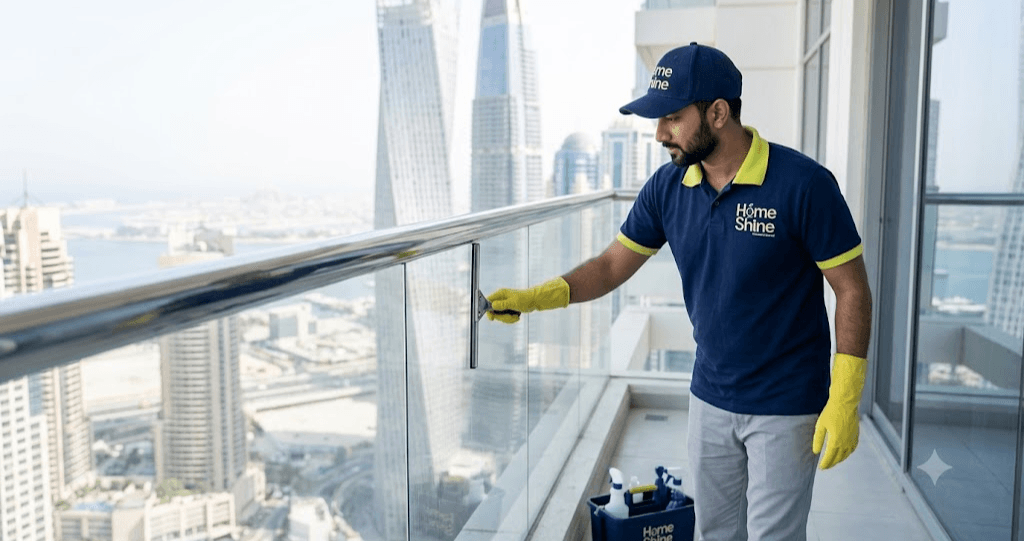
Glass railings need a non-abrasive approach. Start by wiping with damp microfiber cloths to remove sand, then apply a suitable glass cleaner with a squeegee to avoid streaks, which can form quickly in Dubai's heat due to rapid evaporation. Metal railings, whether powder-coated aluminium or stainless steel, should be checked for hard water stains and, on coastal balconies near the beach, signs of salt air corrosion. Natural stone or porous tile absorbs water differently from glazed tile, so excessive water use can allow moisture to penetrate the surface. On upper-floor balconies, poorly controlled water use can become a problem if drainage is inadequate or the waterproofing is already compromised.
Handling pigeon droppings safely
Pigeon droppings on a Dubai balcony are more than a cosmetic issue, and that difference affects how they need to be cleaned.
Dried droppings can stain surfaces and, if left in place for extended periods, may damage some paint, stone, or metal finishes. Beyond surface damage, dried droppings may contain bacteria, fungal spores, and other pathogens that can become airborne when disturbed by sweeping, scraping, or wind. Disturbing dried droppings can create airborne dust that may pose a respiratory concern, particularly for people with asthma or weakened immune systems. They should not be swept away like regular dirt.
Softening droppings first is both safer and more effective. Use a damp cloth or a light spray rather than scraping or striking them while they are dry. After softening, the droppings can be gently lifted or wiped away without creating the dust that dry scraping produces. The affected surface should then be disinfected rather than simply rinsed, since rinsing alone spreads residue into surrounding grout lines and drainage channels instead of removing it.
Gloves and, ideally, a basic mask are worth using for any accumulation beyond light, occasional marks, particularly on balconies where droppings have built up over several weeks near an AC condenser or a favoured ledge. If pigeons keep returning to the same spot, cleaning alone will not solve the problem. That is a deterrent issue, typically addressed with netting or spike strips from a pest control specialist.
Post-sandstorm balcony cleanup: the right order of operations
A sandstorm changes the cleanup task from routine maintenance to recovery, and the order of operations matters more here than with regular upkeep.
1. Let particle levels settle before starting. Cleaning during the tail end of a storm only means repeating work within the hour. Once the storm has passed and the wind and airborne dust have settled, cleaning can begin.
2. Remove loose sand and debris first. Use a suitable vacuum or carefully collect larger debris before applying any water. Skipping this and going straight to hosing turns loose sand into a gritty slurry that is harder to clean and can clog balcony drains.
3. Damp-wipe fine residue. Once loose material is cleared, a damp microfiber cloth or mop picks up what remains without redistributing it. This is the same principle that applies to routine cleaning, just with a heavier accumulation after a storm.
4. Check and clear the drain before finishing. Balcony drains are exactly where displaced sand tends to collect during a storm cleanup, and a blocked drain becomes a real problem the next time it rains. Standing water can increase the risk of water intrusion, particularly where drainage or waterproofing is already compromised. This step is skipped more often than any other in DIY cleanups, largely because the problem is not visible until water starts pooling.
5. Address sliding door tracks separately. Sand collects in balcony door tracks and gets compacted every time the door is opened or closed, eventually making the door harder to slide. A narrow crevice brush or vacuum crevice attachment clears this before it becomes a mechanical issue rather than just a cleanliness one.
6. Inspect furniture and soft furnishings last. Outdoor cushions, rugs, or fabric furniture on the balcony often need to be aired out, brushed down, or in some cases sent for cleaning separately, since fine sand embeds into fabric weave in a way that a quick wipe does not address.
Following this sequence, rather than jumping straight to hosing the whole balcony down, makes cleanup faster and prevents loose sand from turning into a gritty paste that is harder to remove.
Common mistakes that make balcony cleaning harder
Pressure-washing a surface before checking its condition. High-pressure water on porous stone, older grout, or a balcony with an aging waterproof membrane can push water into places it should not go, particularly relevant on upper floors where the balcony sits directly above another unit's ceiling. A low-pressure spray rinse is more suitable for most residential balconies.
Rinsing dried droppings away with a hose before removing the solid material. Water alone spreads dried droppings and their residue over a larger area, especially into grout lines and drain channels where they are much harder to reach afterward.
Using a standard vacuum to remove fine sand. Without HEPA filtration, the vacuum blows the finest particles back into the air, giving the appearance of cleaning while redistributing dust.
Skipping the drain check. A drain may look fine until water starts pooling, at which point a blockage can become a significantly larger problem.
Using glass and stone cleaning products interchangeably. A glass cleaner may leave a residue or dull film on natural stone, while an abrasive cleaner intended for some stone surfaces may scratch glass. Matching products to surfaces avoids either outcome.
How often should a Dubai balcony be cleaned?
Routine cleaning, a sweep and a damp wipe, is worth doing weekly for most Dubai balconies, since sand and humidity residue build up quickly. A more thorough clean covering railings, glass, drains, and furniture can be done monthly for regularly used balconies. Balconies with heavy pigeon activity or greater exposure to sand and coastal conditions may need this every two to three weeks.
Beyond routine maintenance, a full balcony deep clean is worth scheduling after any sandstorm, at least once per season even without a storm, before hosting guests, during a move in or move out, and any time droppings have built up rather than being addressed as they appeared.
DIY vs professional balcony cleaning: where to draw the line
Light, regular cleaning including weekly sweeping, a damp wipe-down, and prompt attention to fresh droppings is manageable for most residents without specialist equipment.
The line shifts toward professional balcony cleaning when the work involves grime that has bonded to surfaces over weeks or months, significant droppings buildup, or railings and glass that are difficult or unsafe to reach from inside the unit. Professional help is also more appropriate when a blocked drain needs clearing, or when pressure washing involves stone, grout, or aging waterproofing.
The risk increases when cleaning involves high pressure washing, aggressive scrubbing on fragile surfaces, blocked drains, or unsafe access from a height. Surface damage, drainage problems, or personal injury from an unstable position are all real possibilities when these tasks are handled without the right equipment. Professional balcony cleaners use appropriate tools and methods for different surfaces, handle significant droppings buildup without relying solely on rinsing, and know how to work around drains and waterproofing without creating a downstream problem.
Book balcony cleaning with HomeShine
HomeShine offers balcony cleaning as a standalone service and as part of selected home deep-cleaning packages. Same-day availability across Dubai.
Book NowFrequently asked questions
Is it safe to clean pigeon droppings myself?
Small amounts of fresh droppings can often be cleaned by residents using gloves, damp cleaning methods, and an appropriate disinfectant. Larger accumulations, particularly those built up over several weeks, carry enough of a respiratory risk from airborne particles that professional cleaning is a more sensible choice, especially for anyone with asthma or a similar condition.
How soon after a sandstorm should a balcony be cleaned?
Once the storm has passed and airborne dust and strong winds have settled. Cleaning too early means repeating the work, and waiting too long lets fine sand mix with overnight humidity and bond to the surface.
Why does my balcony still look dusty right after I clean it?
This is usually a filtration or method problem. A vacuum without proper HEPA filtration, or dry sweeping fine sand, redistributes the finest particles into the air instead of removing them, so they resettle within a short time.
Can pressure washing damage my balcony?
It can, particularly on porous natural stone, older grout, or balconies with an aging waterproof membrane. High-pressure water can push moisture into the surface or substrate rather than off it. A controlled, low-pressure rinse is generally a safer approach for residential balconies.
Do I need a separate service for pigeons that keep coming back?
Yes. Cleaning removes the mess, but if pigeons consistently return to the same ledge or railing, that is a deterrent issue. It is typically addressed with netting or spike strips from a pest control specialist, which is separate from balcony cleaning.
Does HomeShine clean balconies as a standalone service?
Yes, HomeShine offers balcony cleaning as a standalone service and as part of selected deep-cleaning packages in Dubai.