 Claude
 Perplexity
- Dubai Municipality guidelines require potable water storage tanks to be cleaned and disinfected at regular intervals, with a six-month interval commonly specified for residential properties.
- Villa owners are generally responsible for arranging their own tank cleaning; apartment tenants rely on building management for shared systems.
- Dubai's heat accelerates bacterial growth, making the six-month interval particularly relevant to the local climate rather than an arbitrary rule.
- Cleaning must be carried out by a Municipality-approved contractor using approved disinfectants, and documentation of each service should be retained.
- Skipping tank cleaning can lead to microbial contamination, discoloured water, odour, and regulatory exposure for property owners.
Many properties in Dubai rely on water storage tanks, whether located underground, on a villa rooftop, or as part of a shared building water-storage system. The tank is an important storage point before water reaches household outlets, so poor tank maintenance can affect the quality of water throughout the property's internal plumbing system.
Dubai Municipality has established guidelines for how frequently these tanks are to be cleaned, and the reason for those guidelines has more to do with the climate of the region than with general hygiene. This guide explains what Dubai Municipality expects, why six-month intervals matter, and how villa and apartment residents should approach compliance. It also covers what happens when tank cleaning is deprioritised, and what a proper professional cleaning service should include so property owners can recognise when they are being shortchanged.
Also useful:
AC Filter Cleaning in Dubai: How Often to Do It
Rug Cleaning in Dubai: How It Differs from Carpet Cleaning
Kitchen Deep Cleaning in Dubai: What It Covers and How Often to Book
What does Dubai Municipality require for water tank cleaning?
Dubai Municipality guidance requires potable water storage tanks to be cleaned and disinfected at regular intervals, with a six-month interval commonly specified for residential properties. Property owners should confirm the latest requirements applicable to their property type. This applies to an above-ground tank on a villa rooftop, an underground tank, and centrally located tanks serving apartment buildings.
The requirement is not dependent on the appearance or flavour of the water. A tank may look clean while still containing microorganisms or other contaminants that are not visible to the naked eye. This is why tank cleaning should be treated as preventive maintenance rather than something to schedule only after a visible problem appears.
Higher-risk premises such as hotels, schools, hospitals, and labour accommodation may require more frequent cleaning or additional maintenance controls, given the number of individuals relying on the same water supply. For a typical villa or apartment, six months is a useful baseline for scheduling water tank cleaning, subject to the latest requirements applicable to the property.
Cleaning should only be done by a contractor approved by the Municipality, using approved disinfectants. This detail matters more than it might appear, since it directly affects whether a property is compliant.
Why Dubai's climate makes this important
The primary purpose of Dubai's water tank cleaning regulations is to protect public health, and the local climate is a significant factor. Dubai's summer temperatures regularly exceed 40°C, and a rooftop tank in direct sun will absorb this heat and raise the temperature of the water stored inside. Warm, still water is an environment where bacteria and biofilm can establish themselves more readily.
Dust is the second factor. Dubai's airborne particles can enter tanks through vents, inspection covers, or openings around fittings that are not tightly sealed. Over time, accumulated dust and organic particles settle at the base of the tank and contribute to sediment buildup, creating conditions that support microbial growth.
Underground tanks are protected from direct sunlight but can be harder to inspect because they are less accessible. They should be cleaned and inspected according to the same applicable maintenance requirements, rather than being overlooked simply because they are out of sight.
Villa owners vs apartment residents: who is responsible?
For standalone villas, responsibility for arranging water tank cleaning generally falls to the property owner, although tenants may arrange maintenance depending on their tenancy agreement. This applies in communities such as Arabian Ranches, Al Barsha, Dubai Hills, JVC, and Al Furjan. A villa can have one or two tanks, typically an underground tank and a rooftop or overhead tank, and both should be cleaned. Cleaning one while leaving the other untreated means sediment or microbial contamination can remain in the water-storage system.
Apartment residents typically rely on shared building water storage systems, with maintenance managed by the building's facilities team. Most tenants cannot book cleaning for a shared system individually, but that does not mean the question is irrelevant to them. In older buildings, or where maintenance schedules are not actively communicated to residents, it is worth asking building management directly when the tank was last serviced and whether documentation is available.
Landlords and property managers with multiple properties carry the most direct compliance responsibilities. Keeping a simple record of cleaning dates makes it significantly easier to stay ahead of the six-month cycle than to discover a gap has opened up after a tenant complaint or a property inspection.
What happens if you skip water tank cleaning?
The consequences of skipping tank cleaning fall into two categories: health risk and regulatory exposure.
Health risk is the more immediate concern. Poorly maintained water storage systems can create conditions that support microbial growth, including microorganisms associated with gastrointestinal illness. Households with young children, elderly residents, or anyone with a weakened immune system carry a higher risk from contaminated water. Even without more serious outcomes, an uncleaned tank often produces noticeable problems: discoloured water, a musty or unpleasant odour, sediment visible in the water flow, or reduced pressure if debris has partially blocked the outlet or foot valve.
Regulatory exposure is the second concern. Failure to meet applicable Dubai Municipality requirements may expose property owners or managers to enforcement action or penalties, depending on the circumstances. Property owners are also expected to maintain documentation of each cleaning and disinfection service in case it is requested during an inspection. If a villa or apartment building has never had its tank cleaned, or nobody can confirm when it last happened, it should be treated as a priority rather than something to fit around other maintenance tasks.
Professional cleaning process: what should actually happen
A proper water tank cleaning service should follow a structured process rather than a quick rinse. Understanding each step helps property owners recognise whether a service is thorough or cutting corners.
Inspection. A technician should assess the tank's location, material, size, and condition before starting, noting any visible algae, rust, or structural concerns that might affect the cleaning approach.
Draining. The tank is fully drained to remove standing water along with any loose sediment or debris.
Sludge and sediment removal. Accumulated sludge at the base of the tank is manually removed. This is where the heaviest bacterial concentration typically sits and it cannot be addressed by flushing or rinsing alone.
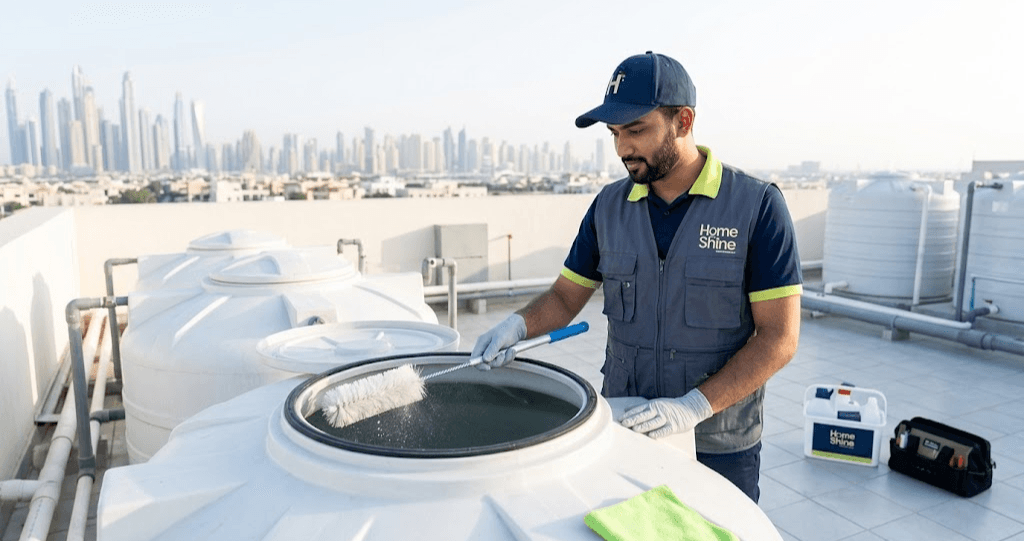
Scrubbing and high-pressure washing. Interior walls and the base are scrubbed to dislodge algae, mineral deposits, and biofilm. Concrete, fibreglass, and plastic each respond differently to cleaning methods, so brushes and equipment should be suited to the tank material. Pressurised water then clears remaining residue that scrubbing alone might miss.
Disinfection. A Municipality-approved disinfectant is applied to eliminate remaining bacteria. This step is what separates a compliant cleaning from a basic rinse, and it is also the step most likely to be skipped or done inadequately by unlicensed providers.
Rinsing. The tank is rinsed thoroughly so no disinfectant residue ends up in the water supply once the tank is refilled.
Refill and final check. The tank is refilled, and the technician should confirm the float valve is regulating properly, check for leaks at connections, and run the taps to verify the water flows clear before leaving.
For a villa with two tanks, the duration varies depending on tank size, accessibility, condition, and the amount of sediment buildup. Apartment building tanks, being larger and often requiring confined space access for underground units, can take considerably longer.
Common mistakes property owners make
Assuming clear water means a clean tank. Bacterial contamination is not visible in most cases. Waiting for a visible problem before scheduling cleaning means the tank has likely already been overdue for some time.
Treating DIY cleaning as sufficient. It is technically possible for someone to drain and scrub a small, accessible tank. For properties subject to Dubai Municipality requirements, owners should use an appropriately approved contractor and follow the applicable cleaning and disinfection requirements. Confined space entry, correct disinfectant handling, and reassembling float and foot valves correctly are also easy to get wrong without proper training.
Cleaning only one tank in a two-tank villa system. If a villa has both an underground and a rooftop tank, cleaning one while leaving the other untreated means the second tank's sediment or microbial buildup continues to affect the property's water-storage system.
Not keeping documentation. Even when cleaning is done on schedule, failing to retain records of each service makes it harder to demonstrate compliance and harder to track when the next cleaning is actually due.
Assuming apartment tenants have no role. While building management typically holds responsibility for shared tanks, tenants who never ask about maintenance history have no way of knowing whether their building is actually keeping to schedule.
How often should you clean your water tank in Dubai?
The commonly used baseline is every six months for standard residential properties, whether a villa or an apartment building. Property owners should confirm the latest Dubai Municipality requirements applicable to their property type.
Some situations call for more frequent attention:
- Tanks exposed to direct, prolonged sun, typically rooftop tanks in villas without shading
- Older tanks, particularly concrete tanks, which are more porous and prone to mineral deposits compared to plastic or fibreglass
- Properties where a recent plumbing repair may have introduced dirt or debris into the system
- High-occupancy or high-usage properties, including larger family homes or properties with frequent guests
If none of these apply, a six-month schedule is a reasonable default to build into a household's broader home maintenance calendar, alongside seasonal deep cleaning and AC servicing.
Book water tank cleaning with HomeShine
HomeShine technicians use Municipality-approved products and provide full documentation of every service. Same-day availability for villas and apartments across Dubai.
Book NowFrequently asked questions
What is Dubai Municipality's minimum requirement for water tank cleaning?
For standard residential properties, six months is the commonly specified cleaning interval. Property owners should confirm the latest Dubai Municipality requirements and use an appropriately approved contractor.
Is water tank cleaning required for both villas and apartments?
Yes. A six-month requirement applies across property types, though for apartments the responsibility usually sits with building management rather than individual tenants.
What bacteria can grow in an uncleaned water tank?
Legionella and E. coli are the most commonly cited concerns, both associated with serious health risks when water systems are not properly maintained.
How long does a typical water tank cleaning take?
A standard villa with two tanks generally takes between two and five hours. Larger or harder-to-access systems, such as those in apartment buildings, can take longer.
Does the type of tank material affect cleaning frequency?
Tank material can affect how a tank should be inspected and cleaned. Concrete surfaces may be more porous than plastic or fibreglass tanks, so their condition and any buildup should be assessed during routine maintenance.
What should I check for in a water tank cleaning service provider in Dubai?
Confirm the provider is Municipality-approved, uses approved disinfectants, and provides documentation of the service including before-and-after details where possible.