 Claude
 Perplexity
TL;DR
- An office cleaning AMC (Annual Maintenance Contract) gives you a predictable cost and a fixed service standard, unlike ad hoc bookings that vary in price and scope.
- Business Bay, JLT and DIFC each have distinct building rules, access requirements and cleaning frequencies that a well-written AMC must reflect.
- A contract without defined SLAs, clear staffing terms and a documented scope of work is difficult to enforce when service levels drop.
- Pricing models vary. Understanding daily rate, per-square-foot and bundled models helps you compare quotes accurately and avoid hidden costs.
For most Dubai offices, cleaning is handled reactively: call a provider when the space looks bad, pay a variable rate, and repeat. An office cleaning AMC replaces that cycle with a structured agreement covering regular visits, defined standards and fixed annual pricing. It is increasingly common in Business Bay, JLT and DIFC, where building management offices, free zone authorities and corporate landlords set their own expectations around tenant premises.
This guide covers what a well-structured office cleaning AMC in Dubai should include, how the three districts differ in their practical requirements, and what to look for when comparing providers and reviewing contract terms.
Also read
What is an office cleaning AMC and how does it differ from ad hoc bookings?
An Annual Maintenance Contract for office cleaning is a fixed-term service agreement between a business and a cleaning provider. The contract sets out the frequency of visits, the scope of work covered on each visit, the staffing arrangement, the response time for reactive requests, and the annual fee.
Ad hoc bookings, by contrast, are one-off or periodic engagements with no binding service standard. Pricing changes with demand, staffing may vary between visits, and there is no mechanism for the client to hold the provider to a defined level of service. For small offices with infrequent cleaning needs, ad hoc bookings are sufficient. For businesses with daily or near-daily cleaning requirements across a larger footprint, an AMC provides consistency and accountability that ad hoc arrangements cannot.
A Dubai office cleaning AMC typically runs for 12 months, with an option to renew. Some providers offer six-month contracts for tenants in short-term leases, though pricing per visit is usually higher on shorter terms.
Why Business Bay, JLT and DIFC have different requirements
The three districts differ in their building management structures, free zone regulations and typical office types. These differences affect access procedures, cleaning frequency and the practical scope of work a provider must be able to cover.
Business Bay
Business Bay is a freehold commercial district with a mix of standalone towers and podium developments. Building management varies by tower, so access procedures for cleaning staff, including ID registration, gate passes and working hour restrictions, differ from one building to the next. Offices here range from small single-floor tenancies to multi-floor corporate suites, and cleaning frequency requirements reflect that range.
Many Business Bay towers have loading bays and service lifts with time-restricted access. A cleaning provider that has not worked in the district before may underestimate the logistics involved in getting staff and equipment to upper floors during morning and evening rush periods. Confirm that your provider has existing relationships with building management teams in your specific tower before signing.
JLT (Jumeirah Lakes Towers)
JLT is a DMCC free zone, and businesses registered there must ensure that any service provider working on their premises meets DMCC compliance requirements. This includes having valid trade licences, appropriate insurance coverage, and in some cases approval for workers entering the cluster. The free zone's high-density layout, with clusters of towers sharing podium levels and shared parking structures, also means cleaning staff need specific access cards for some common areas.
JLT offices tend to be smaller than Business Bay counterparts, and many tenants share floors with other businesses. A cleaning AMC must clearly define which areas are within scope, particularly in shared-floor situations where corridor, pantry and lobby cleaning responsibilities may not be self-evident.
DIFC (Dubai International Financial Centre)
DIFC has its own regulatory framework and its own facilities management requirements. Tenants in the Gate Building, Burj Daman and surrounding towers operate under DIFC Authority rules, and any service provider working within the free zone must hold the appropriate approvals. After-hours access is common for cleaning work in DIFC offices, given the client-facing nature of many tenants and the requirement that premises be in presentable condition before business hours.
DIFC also has stricter waste disposal and chemical usage rules than the broader Dubai market. An AMC with a DIFC-registered office should specify the cleaning products used and confirm that the provider's chemical handling meets free zone standards.
What a complete scope of work should include
A vague scope of work is the most common source of dispute in cleaning contracts. Define each area of the office and the tasks covered on each type of visit. A thorough AMC scope typically includes the following categories.
Daily tasks should cover floor vacuuming and mopping, workstation and desk surface wiping, bin emptying, kitchen and pantry cleaning (including appliance exteriors and sink), toilet and washroom sanitisation, glass partition and interior door wiping, and reception and entrance area maintenance.
Weekly tasks typically include skirting board wiping, interior window and glass cleaning, AC vent and grille dusting, upholstery vacuuming on office chairs and meeting room seating, and deep kitchen cleaning including appliance interiors.
Monthly or quarterly tasks cover deep cleaning cycles including carpet extraction, tile grout cleaning in washrooms and pantries, full internal window cleaning, ceiling and high-surface dusting, and storage room cleaning.
Confirm which deep clean tasks are included in the AMC fee and which are quoted separately. Many contracts include a quarterly deep clean as standard; others treat it as a chargeable add-on.
SLA and KPI terms to include
A contract without enforceable SLAs gives the client no recourse when service quality drops. The following terms are worth negotiating before signing.
Response time for reactive requests. Define how quickly the provider will respond to a call-out outside of scheduled visits. A four-hour response window during business hours is a reasonable standard for most office environments.
Complaint resolution process. The contract should describe how complaints are logged, acknowledged and resolved, including the escalation path if the first-line response does not address the issue.
Quality inspection schedule. Require the provider to conduct documented site inspections at a defined frequency, typically monthly, with a written report shared with the client. This creates an audit trail and makes it easier to demonstrate non-performance if contract renewal becomes contentious.
Staff consistency. High staff turnover is common in the cleaning industry. A commitment to notify the client of staff changes, and to introduce replacement staff before their first solo visit, reduces the disruption that unannounced changes cause.
Staffing, compliance and insurance
The provider's staffing and compliance position directly affects your liability as the contracting party. Request documentation for the following before signing.
Valid Dubai trade licence. Confirm the licence covers cleaning services and is current. DMCC and DIFC-registered providers also need the relevant free zone approvals if your office is in one of those jurisdictions.
Workers' compensation and public liability insurance. The provider should carry adequate insurance for injuries occurring on your premises and for any accidental damage caused during cleaning. Request a certificate of insurance naming your company as an additional insured where possible.
MOHRE compliance. Staff should hold valid UAE residency and work permits. Ask whether the provider conducts regular compliance checks and whether your office is covered if a staff member is found to be non-compliant during a building access check.
Security clearance for DIFC and DMCC. Both free zones require cleaning staff to hold specific access approvals. Confirm the provider has completed this for the staff who will work at your premises, not just at the organisational level.
Pricing models: how to compare quotes
Dubai cleaning providers use several pricing structures, and comparing quotes without understanding the model can lead to misleading cost comparisons.
Daily rate model. The provider charges a fixed daily rate per visit. Simple to track against the contract, but the total annual cost depends on the agreed visit frequency. Confirm whether bank holidays and public holidays are included or excluded.
Per-square-foot model. Common for larger offices, this model scales the monthly fee to the office footprint. Useful for multi-floor tenants, but verify exactly which areas are included in the measured footprint and whether the rate changes for washroom and kitchen areas, which require more intensive cleaning per square foot.
Bundled model. An all-inclusive monthly fee covering regular visits, reactive call-outs up to a defined limit, and a set number of deep cleans per year. The most predictable model for budgeting, provided the bundle clearly defines what is included and what triggers a surcharge.
When comparing quotes, build a cost-per-visit figure by dividing the annual fee by the total number of scheduled visits. This normalises the comparison across providers using different pricing models.
Contract term, renewal and termination
Most office cleaning AMCs in Dubai run on a 12-month term with automatic renewal unless either party gives notice. The following terms are worth reviewing carefully.
Notice period for termination. A 30-day notice period is standard. Some contracts require 60 or 90 days, which can create problems if you are vacating the office or changing providers close to a lease end date.
Early termination clause. Understand what fee applies if you terminate before the contract end. Some providers waive the penalty if the office is being vacated; others apply a fixed percentage of the remaining contract value.
Price escalation on renewal. Many contracts include a provision for the provider to increase the annual rate on renewal, typically tied to a CPI index or a fixed percentage. Negotiate a cap before signing the initial contract, not at renewal time.
Performance-based termination right. Where possible, include a clause that allows you to terminate without penalty if the provider fails to meet defined SLAs after a documented remediation period. This clause is rarely offered by default but is often accepted if requested.
Red flags to watch for when reviewing a contract
Certain patterns in a proposed contract should prompt further negotiation before signing.
Scope described in general terms only. Phrases such as "standard office cleaning" with no breakdown by area or task frequency make it impossible to verify whether the service was delivered as agreed.
No defined staffing level. If the contract does not specify how many staff will be assigned per visit, the provider can reduce headcount without technically breaching the agreement.
Chemicals and equipment not specified. For DIFC tenants in particular, the absence of a product list leaves you unable to confirm compliance with free zone chemical use rules.
No inspection or reporting obligation. A provider that is not contractually required to document quality checks has no incentive to conduct them consistently.
Automatic renewal with no notice to the client. Some contracts renew automatically unless the client cancels within a narrow window, which can trap tenants in a second term with a provider they intended to replace.
How to compare providers: a step-by-step approach
Working through the following steps before selecting a provider reduces the risk of choosing on price alone and discovering the shortcomings later.
First, prepare a site specification listing your office footprint by area type (open plan, meeting rooms, kitchen, washrooms, reception), your preferred visit frequency, and any district-specific requirements such as DMCC or DIFC approvals.
Second, request itemised quotes from at least three providers, asking each to price against your specification rather than their standard package. Itemised quotes make it possible to compare scope as well as cost.
Third, verify trade licence, insurance documentation and free zone approvals before shortlisting. A provider that cannot supply these documents promptly is unlikely to maintain compliance through the contract term.
Fourth, ask for references from current clients in the same district, not just general client lists. Business Bay, JLT and DIFC each have specific logistics that only providers with active experience in those towers will have resolved.
Fifth, run a trial visit before signing the annual contract where the provider allows it. A trial is the most reliable way to assess the quality of the staff assigned to your account and the provider's communication during a first engagement.
What HomeShine covers under an office cleaning AMC
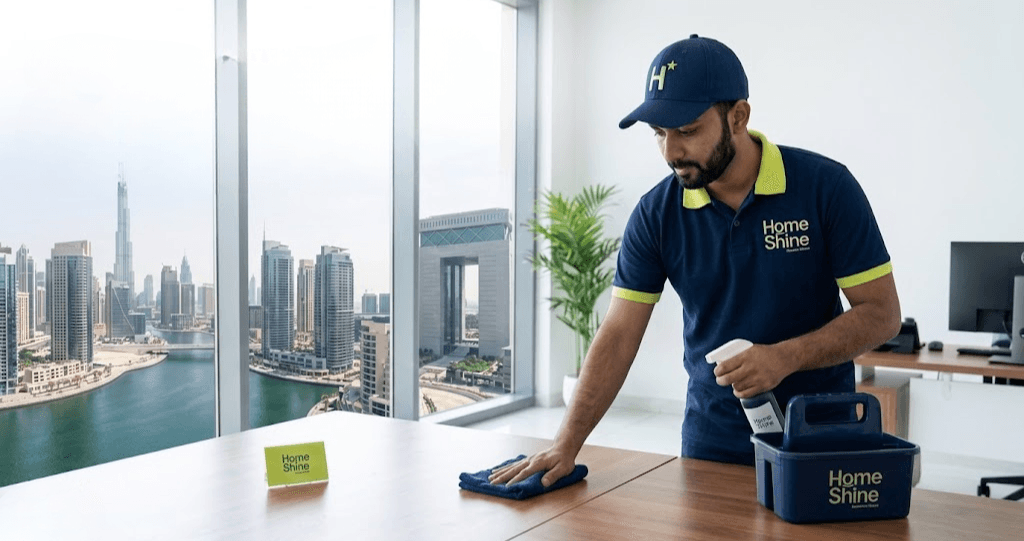
HomeShine provides office cleaning AMCs for businesses in Business Bay, JLT, DIFC and across Dubai. Contracts are scoped to the specific office layout and visit frequency, with defined daily, weekly and deep clean tasks listed in the agreement. Staff assigned to each account hold the relevant building access approvals for their district, and site inspections are conducted monthly with a written report shared with the client.
Insurance documentation, trade licence and any free zone approvals are provided at the quoting stage, before any contract is proposed. Pricing is available on a daily rate, per-square-foot or bundled model depending on the office size and cleaning frequency required.
Get an office cleaning AMC quote for your Dubai office
Business Bay, JLT, DIFC and beyond. Tell us your office size and visit frequency and we will send a detailed scope and fixed annual price.
Book NowFrequently asked questions
What is included in a standard office cleaning AMC in Dubai?
A standard AMC covers daily tasks such as vacuuming, mopping, bin emptying, washroom sanitisation and surface wiping, plus weekly tasks including AC vent dusting and glass cleaning, and quarterly deep cleans covering carpet extraction and tile cleaning. The exact scope should be listed in the contract by area and task frequency rather than described in general terms.
Do cleaning providers need DMCC or DIFC approval to work in those free zones?
Yes. Both DMCC (JLT) and DIFC have approval requirements for service providers working on tenant premises. Providers should hold the relevant trade licence endorsements or free zone approvals and be able to produce documentation at the quoting stage. Staff working in DIFC must also hold individual access approvals for the relevant buildings.
What is a reasonable SLA response time for reactive cleaning requests?
Four hours during business hours is a common benchmark for Dubai office AMCs. For high-footfall environments such as reception areas and client meeting rooms, a two-hour response may be justified. Define the response window in the contract rather than relying on verbal assurances.
How should I compare cleaning AMC quotes that use different pricing models?
Divide the annual fee by the total number of scheduled visits to get a cost-per-visit figure across all quotes. Then check that the scope per visit is comparable: a lower cost-per-visit that excludes washroom deep cleaning or weekly AC vent dusting is not a like-for-like comparison with a higher quote that includes them.
What happens if a cleaning provider consistently fails to meet the agreed standard?
The contract should include a documented complaint resolution process and, ideally, a performance-based termination clause that allows you to exit without penalty after a defined remediation period has passed without improvement. Without this clause, poor performance becomes difficult to act on before the contract term ends.
Is an annual contract necessary or can I use ad hoc bookings for office cleaning?
Ad hoc bookings work for small offices with infrequent cleaning needs. For offices requiring daily or near-daily cleaning, an AMC provides a fixed cost, a defined standard and an enforceable agreement, none of which ad hoc arrangements offer. The predictability also makes facilities budgeting more straightforward for finance teams managing multiple cost lines.