 Claude
 Perplexity
- Regular bathroom cleaning removes surface grime but will not remove hardened limescale, embedded grout stains, or mineral deposits in showerheads and taps.
- Two factors drive faster buildup in Dubai: mineral deposits left by repeated water evaporation, and moisture that lingers in poorly ventilated bathrooms.
- A professional deep clean works fixture by fixture: toilet, shower and bathtub, tiles and grout, sink and taps, mirrors and fittings, and the exhaust fan.
- Knowing what a real deep clean covers helps you judge whether a service is doing a thorough job or simply a surface wipe with a longer invoice.
This article is for Dubai homeowners, apartment residents, villa owners, and tenants who want to understand what a professional bathroom deep cleaning actually includes before booking one.
Two factors commonly affect bathroom maintenance in Dubai: mineral deposits from water, and moisture that can linger in poorly ventilated spaces. Both leave residue that a standard wipe-down cannot remove, and both accumulate faster here than in temperate, soft-water climates. This article explains what professional bathroom deep cleaning covers, why Dubai bathrooms require it more often than generic cleaning advice suggests, and how to tell a genuine deep clean from a surface-level service.
Also useful:
Balcony Cleaning in Dubai: Sand, Pigeon Mess, and Post-Sandstorm Cleanup
Water Tank Cleaning in Dubai: Dubai Municipality Rules
AC Filter Cleaning in Dubai: How Often to Do It
Why Dubai bathrooms need more than regular cleaning
Dubai's water can vary in mineral content depending on the source, building, and plumbing system. Each time mineral-rich water lands on a surface and evaporates, it leaves behind deposits of calcium and magnesium, creating the chalky buildup known as limescale. This coats showerheads, glass doors, chrome taps, and tile grout. Regular cleaning removes soap residue and dust but will not remove mineral deposits that have already adhered to a surface. Limescale requires an acidic cleaner and contact time to break down, neither of which a daily or weekly clean typically provides.
The second factor is humidity cycling. Showering introduces steam into a confined space, and that steam must escape. In apartments without windows where the exhaust fan is weak or poorly maintained, moisture accumulates in grout lines, silicone seals, and the exhaust fan housing itself. Mold and mildew grow in exactly these areas, typically in spots not reached by regular scrubbing.
Villas may have better natural ventilation in some bathrooms, but they are not exempt from limescale or mold buildup. Villa properties may also require more time overall when they contain multiple bathrooms or larger bathroom areas.
What a bathroom deep clean actually covers, fixture by fixture
A professional deep clean is not one task. It is a sequence of fixture-specific processes, each requiring different tools and cleaning agents.
Toilet: beyond the visible bowl
Water-line stains and mineral deposits are removed from the toilet bowl using a disinfecting scrubber. Technicians also clean behind the seat, around the base, under the rim, and around the hinges, which are areas routinely overlooked during regular cleaning and where grime and bacteria accumulate. The flush handle and any visible pipework are wiped and disinfected, since these are high-touch points that standard cleaning often misses.
Shower and bathtub: where limescale concentrates fastest
Shower areas are the most limescale-heavy zones in a Dubai bathroom because water evaporates from glass, tiles, and metal fixtures multiple times a day. A deep clean applies a descaling solution to glass doors, shower trays, and tap fittings to remove the soap scum and mineral film that a standard spray cleaner cannot reach. Showerheads are soaked or removed to clear the mineral deposits that build up inside nozzles and reduce water pressure over time. The silicone seal around the base of the tub or shower is also inspected for early mold, since silicone retains moisture and is a common site for mildew growth.
Tiles and grout: the area regular cleaning misses most
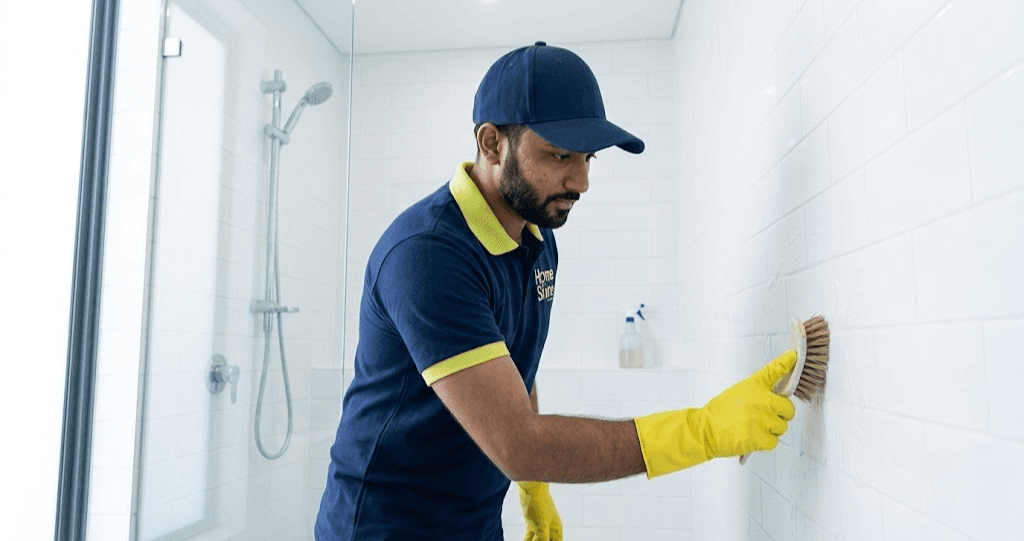
Porous grout retains moisture, dirt, and mineral residue, making it more susceptible to discolouration and mildew growth. Deep cleaning with a rotary grout brush removes embedded dirt from the grout lines themselves rather than just cleaning the surface around them. Tile surfaces are treated for hard-water stains, and early mold staining on grout is addressed rather than wiped over.
Sink and taps: descaling, not just wiping
Taps and sink basins accumulate limescale quickly because they are in contact with water throughout the day. Descaling agents remove mineral deposits from taps, faucet nozzles, and drain covers to restore chrome and steel finishes. The sink basin is cleaned for soap scum and toothpaste residue from its sides and drain.
Mirrors, fittings, and cabinets
Mirrors are cleaned streak-free, and all metal fittings, towel rails, soap dispensers, and cabinet handles are wiped and disinfected. Cabinet surfaces, inside and out where accessible, are included in a thorough service, since these areas collect dust and moisture as readily as open surfaces.
The exhaust fan: the most overlooked step
Bathroom exhaust fans are almost never cleaned during routine tidying, yet they are central to preventing mold. Dust and lint build up on the fan grille and inside the housing over time, reducing suction and making the fan less effective at clearing humid air. A genuine deep clean removes the cover, clears dust from the blades where accessible, and checks that the fan is drawing air properly. This step is particularly important in bathrooms where ventilation is poor, since an underperforming fan directly contributes to the moisture conditions that support mold growth.
DIY vs. professional: where the line sits
Not every bathroom task requires a professional. Daily habits, squeegeeing shower glass after use, wiping down the sink, running the exhaust fan for several minutes after showering, slow the accumulation of limescale and moisture between deep cleans. These are upkeep tasks anyone can do in a few minutes.
Professional deep cleaning becomes necessary when routine cleaning is no longer removing visible buildup or persistent odours. Signs a bathroom needs a deep clean rather than another wipe-down include:
- Limescale that has hardened into a rough, chalky texture on glass or chrome and does not lift with a standard bathroom spray
- Grout lines that have gone visibly grey or show dark spotting even after scrubbing
- Noticeably weaker shower water pressure, often a sign of a limescale-blocked showerhead
- A musty smell that persists after cleaning visible surfaces, which usually points to mold inside the exhaust fan housing or behind fixtures
- Move-in or move-out situations where the previous occupant's buildup needs a full reset
DIY descaling can handle mild limescale with enough time and the right product, but heavier buildup, embedded grout mold, and exhaust fan cleaning generally need the equipment and technique a trained team brings, along with the time most households cannot set aside regularly. For a broader view of what professional cleaning covers, see what a deep cleaning service in Dubai actually includes.
Common mistakes that make bathroom buildup worse
Using harsh products without checking the surface. Bleach and strong cleaners may not be suitable for every silicone seal, rubber fitting, tile, or stone surface. The appropriate product depends on the material and the type of buildup being treated.
Cleaning only the outside of the exhaust fan grille. A fan that looks clean on the exterior may not be operating efficiently if dust has built up inside the housing. Cleaning the grille does not clear the internal blades.
Using an acidic descaler on natural stone or polished tile without testing first. Marble-look finishes are common in many newer Dubai apartments and villas. Acidic descalers can etch or dull these surfaces. Every surface material requires a specific approach, which is why an initial inspection by the technician matters before any treatment is applied.
Relying on a once-a-year deep clean. Limescale and mold-related grime can return within weeks or months depending on bathroom use, ventilation, and local water conditions. A single annual deep clean may allow significant buildup to accumulate between visits.
How often does a Dubai bathroom need a deep clean?
Frequency depends on use, bathroom size, and ventilation. Bathrooms used daily by a family generally benefit from a deep clean every one to two months. Lightly used guest bathrooms can go longer between sessions. Bathrooms without windows or with weak exhaust fans need more frequent attention because there are fewer opportunities for moisture to escape between uses.
Move-in and move-out situations are a separate category. A property recently vacated by a previous occupant usually carries buildup that needs a full reset before a regular maintenance routine can keep pace with it.
Book bathroom deep cleaning with HomeShine
HomeShine technicians follow a fixture-by-fixture process for every bathroom deep cleaning, using descaling techniques suited to Dubai's hard water and eco-friendly products safe for all households. Same-day availability across Dubai.
Book NowFrequently asked questions
How long does a professional bathroom deep cleaning take in Dubai?
A thorough bathroom deep clean typically takes between 45 and 90 minutes, depending on the bathroom's size, the extent of limescale buildup, and whether mold treatment is needed. Larger villa bathrooms or those with multiple fixtures take longer.
Can deep cleaning remove hard water stains from shower glass and taps?
Yes. Professional deep cleaning uses descaling agents suited to dissolving mineral deposits, which restores clarity to glass and shine to chrome fixtures. Mild staining can sometimes be managed with DIY descaling, but hardened limescale generally needs a professional-grade approach.
Is bathroom deep cleaning safe for bathrooms used by children?
HomeShine uses eco-friendly cleaning products designed to be safe for children and pets. Technicians follow standard safety practices during treatment, and bathrooms are left ready for normal use once the visit is complete.
Do apartments and villas need different bathroom cleaning approaches?
To some extent, yes. Apartment bathrooms often rely entirely on an exhaust fan for ventilation, making fan cleaning and mold prevention more critical. Villas tend to have better natural airflow but often include more bathrooms per property, which affects the overall time and scope of a deep clean.
How often should I book a bathroom deep cleaning in Dubai?
Most households benefit from a deep clean every one to two months for frequently used bathrooms, with lightly used guest bathrooms able to go longer between sessions. Bathrooms with weak ventilation or no windows generally need more frequent attention.
What does HomeShine's bathroom deep cleaning service include?
The service covers the toilet, shower and bathtub, tiles and grout, sink and taps, mirrors and fittings, and the exhaust fan, using descaling agents suited to Dubai's hard water and eco-friendly disinfectants throughout. Same-day booking is available across Dubai's residential communities.