 Claude
 Perplexity
TL;DR
- A deep bathroom clean removes limescale buildup, soap film, grime and grout stains that a regular wipe-down leaves behind.
- Work from top to bottom and from dry areas to wet areas, allowing cleaning products to dwell before scrubbing.
- Water evaporation causes mineral scaling; humidity and fine dust contribute to mold, grime and buildup. In Dubai, heavy AC use can also cause condensation on cooler surfaces. A full deep clean every three to four months is a practical baseline; shower heads and tap aerators may need descaling every two to three months.
- Do not use vinegar on marble or other natural stone. Acidic descalers can etch calcareous surfaces permanently.
- When mold keeps returning, glass is heavily etched, grout remains stained, or silicone has deteriorated, professional help is the safer option.
An ordinary wipe may not remove established layers of buildup in a bathroom. Soap residue can harden and combine with minerals from water to form stubborn scum, while grout absorbs moisture and dirt over time. Mineral deposits build up around taps and shower heads. Properly cleaning a bathroom involves treating each problem with the correct product, allowing it to sit for the right amount of time, and working in the correct order so dirt is not redistributed to finished surfaces.
Whether you are in a Dubai Marina tower or a Dubai Hills villa, this guide covers the complete process of maintaining a bathroom, with details about the local conditions that accelerate deterioration.
Read also
What does a bathroom deep clean actually include?
Routine cleaning handles visible dirt on the toilet, sink and floor. A deep clean goes further and covers everything that accumulates out of sight or resists a standard wipe:
- Exhaust fan cover and vents
- Tap aerators and shower heads
- Tile surfaces and grout lines
- Shower glass, door tracks and rubber seals
- Silicone joints around tub, shower tray and basin
- Under toilet rim and around base
- Drains and overflow openings
- Vanity fronts, cabinet interiors and shelves
- Skirting, corners and floor edge
A thorough clean at this level takes roughly two to three hours for a standard apartment bathroom and longer for a villa master bathroom.
Why do Dubai bathrooms need deep cleaning more often?
Soap scum and moisture accumulate in all bathrooms. Dubai imposes a few conditions that accelerate the process.
Mineral scale. Hard water evaporates and leaves dissolved minerals behind. These deposits build up on chrome fittings, glass and tiles, appearing as chalky white crust that accumulates as water repeatedly evaporates from the surface.
Constant humidity. High humidity is common year-round in coastal areas including Dubai Marina, JLT and Palm Jumeirah. Windowless internal bathrooms rely heavily on exhaust fans to remove moisture. A fan with dust buildup is inefficient, leaving room for mold to grow in grout, silicone and ceiling corners.
Fine dust and sand. Growing communities like Dubai Hills, JVC and Arjan contend with desert and construction dust that settles on floors and vents. Gritty particles combined with moisture form a film that dulls tiles and darkens grout.
Heavy AC use. When humid bathroom air contacts cooler surfaces, condensation forms. Mildew typically begins around corners and vents where damp spots persist.
What supplies are needed?
Gathering everything first prevents interruptions once products begin dwelling on surfaces.
Tools: microfiber cloths (separate colors for toilet, sink and glass), soft-bristled scrub brush, old toothbrush for grout, non-scratch scrub pad, squeegee, toilet brush, spray bottles, rubber gloves, eye protection, and a vacuum with a brush attachment for dust in vents and corners.
Products: mild dish soap or a pH-neutral all-purpose cleaner; a limescale remover compatible with your surface (white vinegar suits some chrome and glass but not natural stone); a dedicated grout cleaner or oxygen-based cleaner; toilet bowl cleaner; glass cleaner or diluted vinegar solution; baking soda for gentle scrubbing and drain refreshing.
A steam cleaner can be useful on some compatible surfaces. Follow the equipment and surface manufacturer's instructions, particularly around grout, sealants and heat-sensitive materials.
Which cleaning products should never be mixed?
Safety comes before technique. Several common combinations release harmful gases or damage surfaces:
- Bleach and ammonia produce toxic chloramine vapors.
- Bleach and vinegar (or other acids) release chlorine gas.
- Bleach and toilet bowl cleaners can react the same way, since many bowl cleaners are acidic.
- Hydrogen peroxide and vinegar combine into peracetic acid, which irritates skin, eyes and lungs.
Use each product separately, rinse completely before the next, and never spray over residue from a different cleaner. Keep doors open and the exhaust fan running throughout.
How to deep clean a bathroom step by step
Work from top to bottom and from dry areas to wet areas. Dust and loose debris are cleared first, then cleaners are applied and allowed to dwell, and rinsing and floor cleaning complete the process. This sequence stops drips and dust from falling on already-cleaned surfaces.
Step 1: clear the room and remove dry dust
Remove all bottles, towels, mats, shower caddies and decor. Vacuum or wipe dust from ceiling corners, vents, light fixtures and the top of the mirror. Working dry at this stage prevents dust from turning into paste once water is introduced.
Step 2: apply cleaner to shower, tub and toilet and let it dwell
Apply an appropriate cleaner to shower walls, glass, tub and basin, then allow it to dwell according to the product instructions. Dwell time dissolves soap scum and reduces the friction required during scrubbing, which protects surfaces. Apply toilet bowl cleaner around the inside of the bowl and under the rim and allow it to dwell for the recommended time.
Step 3: clean exhaust fan and vents
Switch off the fan and isolate power before cleaning. Remove the grille if it is designed to be removed, wash it in warm soapy water, and wipe accessible parts with a slightly damp cloth. Do not allow water to enter electrical components.
Step 4: descale taps, shower heads and aerators
For compatible chrome fittings, place a cloth dampened with diluted white vinegar around the affected area for a short period, then rinse thoroughly. For removable shower heads, follow the manufacturer's instructions before soaking in a suitable descaling solution. Gently brush the nozzles to remove loosened deposits. Reduced water flow can have several causes, so check the fitting manufacturer's instructions before attempting further cleaning.
Step 5: scrub tiles and grout
Work tile walls from top to bottom. For glazed tile, use a suitable tile cleaner or mild soap solution with a soft cloth or non-abrasive tool. For grout, apply a dedicated grout cleaner or a baking soda and water paste to the lines, scrub gently with a grout brush or old toothbrush, then rinse thoroughly. Grout lines can collect water residue, soap scum and dirt even when the tile surface around them looks clean.
Step 6: restore shower glass, tracks and silicone
Use a non-scratch pad with a limescale-suited cleaner on glass. Clean sliding door tracks with a small brush, as soap scum and minerals collect in channels. Wipe rubber seals and silicone joints and check for dark spots or peeling. Squeegee glass from top to bottom for a streak-free finish.
Step 7: clean bathtub, basin and vanity
Clean the bathtub with a suitable non-abrasive cleaner and a soft brush or cloth, paying attention to the rim, sides and area around the drain. Acrylic surfaces scratch easily, so avoid abrasive cleaners, hard brushes and rough pads. For the basin and vanity, wipe the countertop, edges, cabinet doors, drawer fronts and accessible areas inside.
Step 8: clean the toilet thoroughly
Scrub the bowl, including under the rim and at the waterline, then wipe the seat, hinges, lid, tank, flush button and base. The floor around the toilet base and the wall behind it deserve extra attention. Clean the toilet last among the fixtures, and keep its cloth and brush separate from those used elsewhere.
Step 9: clean floor drain and shower drain
Remove hair and debris from the drain cover and clean the accessible area with a suitable brush. Avoid pouring boiling water into drains unless the manufacturer specifically recommends it. If a persistent smell remains after cleaning, the drain or plumbing may need further inspection, as the cause may be a drainage, plumbing or ventilation issue.
Step 10: finish with mirrors, rinse and floor
Rinse all surfaces with clean water and wipe dry with microfiber. Clean the mirror last with glass cleaner to prevent overspray landing on already-cleaned surfaces. Sweep or vacuum the floor, mop and dry it. Water left to evaporate rebuilds mineral spots on glass and chrome within days.
How can black mold and mildew be handled safely?
Dark mold-like growth appears on silicone, grout and ceiling corners where moisture remains high. Small surface patches can often be treated with a mold-specific cleaner applied with gloves and eye protection in a ventilated room, then scrubbed and rinsed. A few signs help you decide whether to proceed yourself or call a professional:
- Mold on tile and glass surfaces may be removable with appropriate cleaning, though the underlying moisture source should also be addressed.
- Mold inside silicone usually cannot be removed. The joint should be cut out and resealed.
- Mold that returns quickly after cleaning signals a moisture source such as poor ventilation, a leak or a damp wall.
- Large patches, mold on porous drywall or repeated recurrence justify professional assessment.
The long-term fix is ventilation. Run the exhaust fan during and for 20 to 30 minutes after showers.
Which surfaces need special care?
Marble, travertine and other natural stone. Common in villas and premium apartments in Downtown Dubai and Palm Jumeirah, these stones are sensitive to acids. Vinegar, lemon and most limescale removers can etch the surface and leave dull patches. A pH-neutral stone cleaner is the safe choice. For more on protecting natural stone in a bathroom, see the bathroom deep cleaning Dubai guide.
Acrylic tubs and shower trays. Abrasive powders and hard pads cause fine scratches that trap dirt and dull the finish.
Grout. Unsealed cement-based grout is porous. After cleaning and fully drying, applying an appropriate grout sealer reduces staining and moisture absorption going forward.
What mistakes make a bathroom deep clean less effective?
- Skipping dwell time. Scrubbing immediately wastes effort and increases scratching risk.
- Cleaning from floor upward. Drips and dust land on areas already cleaned.
- Mixing products. Creates health risks and rarely improves results.
- Using vinegar on stone. Etching may require professional honing or polishing to correct.
- Ignoring the exhaust fan. A blocked fan undermines every other effort against humidity and mold.
- Leaving surfaces wet. Water left to evaporate rebuilds limescale within days.
- Scrubbing with metal tools. Steel wool and hard scrapers permanently scratch tiles, tubs and glass.
How often should a bathroom be deep cleaned in Dubai?
For a typical household, a full deep clean every three to four months is a workable baseline. Certain conditions justify a shorter interval:
- Large families or several people sharing one bathroom
- Villas with multiple bathrooms in constant use
- Guest bathrooms in short-term rentals with frequent turnover
- Bathrooms without windows or with weak ventilation
- Visible mold, persistent odor or reduced water flow
Between full deep cleans, descaling shower heads and tap aerators every couple of months prevents thick, hard buildup. holiday home and Airbnb cleaning in Dubai often schedule bathroom deep cleaning between longer stays and before the start of a new tenancy.
When is a professional bathroom deep cleaning the better choice?
| Situation | DIY | Professional |
|---|---|---|
| Moderate buildup on glazed tile and glass | Suitable | Not needed |
| Limescale that has etched glass or chrome | Unlikely to work | Specialist descaling or polishing |
| Grout that remains stained after scrubbing | Limited results | Steam cleaning or resealing |
| Mold recurring in silicone or walls | Short-term fix only | Assessment and resealing |
| Move-in, move-out or tenancy handover | Time consuming | Efficient and consistent |
| Natural stone surfaces | Risk of etching | Specialist products and technique |
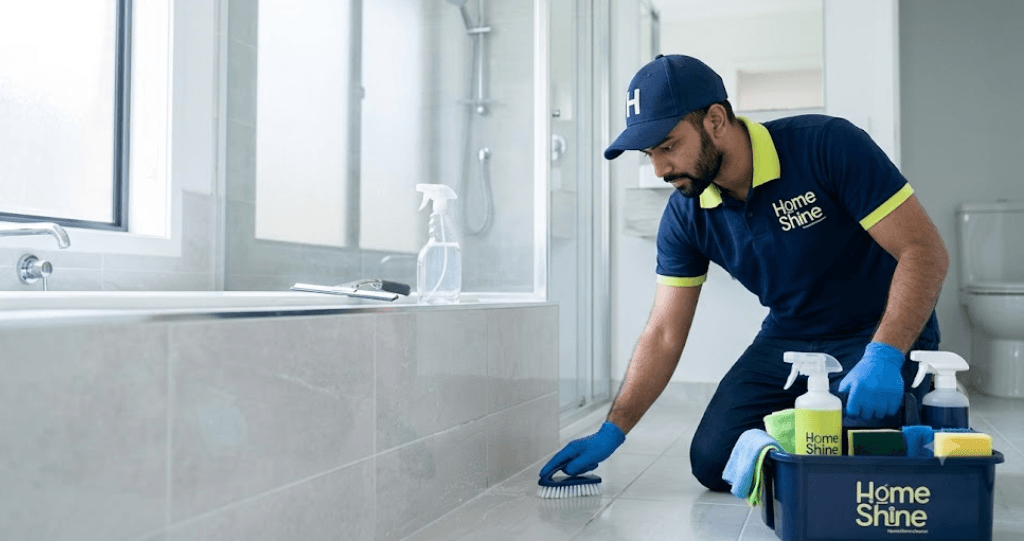
Working professionals, families with young children and tenants preparing for handover often find professional service a practical time-saver. See what a HomeShine deep home cleaning covers across Dubai.
What keeps a bathroom clean between deep cleans?
- Squeegee shower glass and tiles after each use
- Run exhaust fan during and after showers
- Wipe taps and basin surfaces dry daily
- Rinse shower tray and drain weekly
- Clean toilet, sink and floor weekly
A short daily routine and a weekly wipe significantly reduce how much effort a quarterly deep clean requires.
Book a professional bathroom deep clean in Dubai
When buildup has gone beyond what a home clean can fix, HomeShine's deep cleaning service covers bathroom tiles, grout, glass, fixtures and floors across Dubai Marina, JLT, Downtown, Business Bay, Palm Jumeirah, Al Barsha, Dubai Hills, JVC and other communities. Trained technicians, eco-friendly products, transparent pricing and same-day availability.
Book NowFrequently asked questions
How long does it take to deep clean a bathroom?
A standard apartment bathroom generally takes two to three hours when done thoroughly, including dwell time for products. Larger villa bathrooms with tubs, double vanities and glass enclosures take considerably longer.
Is vinegar safe for deep cleaning a bathroom?
Vinegar may be suitable for removing limescale from some compatible chrome, glass and glazed tile surfaces. It should not be used on marble, travertine or other natural stone, and it should never be combined with bleach.
What is the best way to remove limescale in a Dubai bathroom?
Apply a suitable descaler, allow it to dwell, scrub gently and rinse. Wiping surfaces dry after each shower slows the return of scale, since deposits form as water evaporates rather than from the water itself.
How can grout be cleaned without damaging it?
A baking soda paste or a dedicated grout cleaner applied with a soft or medium brush lifts most dirt. Steel brushes and harsh acids can erode grout. Resealing clean, dry grout helps it resist future staining.
Does a professional bathroom deep cleaning service include shower glass and grout?
Scope varies by provider. At HomeShine, the deep home cleaning service covers bathroom fixtures, tiles, glass and floors. The team can advise on additional treatment for issues such as heavy limescale or recurring mold.
How often should a bathroom fan be cleaned?
Cleaning the fan cover every one to two months helps maintain airflow in dusty environments. The fan should be switched off at the wall before any cleaning begins.